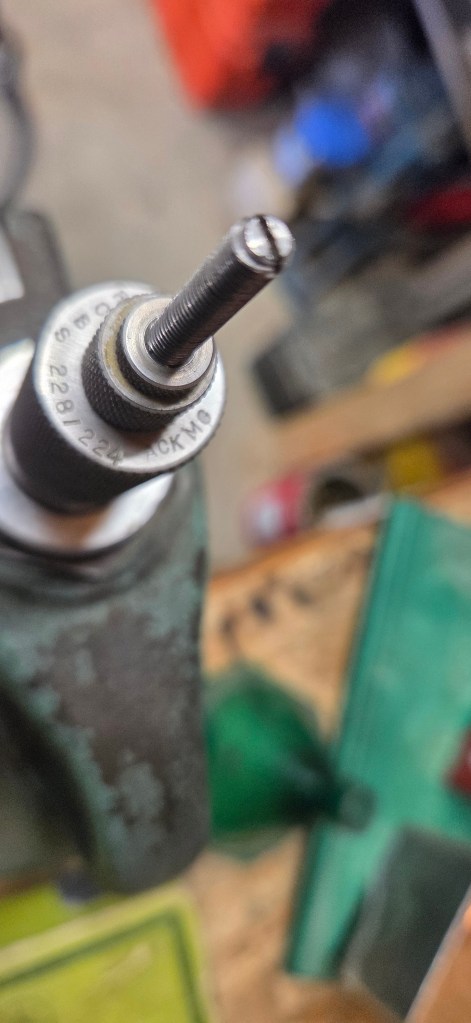
I was approached the other day by a young man who had an old “Nike” shoebox. In the box was a Remington brass bag labeled 257 Roberts with a hand full of loaded cartridges and a few empty casings. The fired cases clearly looking different than those loaded and I noticed the unmistakable sign of a necked down case from its original form. He informed me the rifle belonged to his wife’s grandfather and was purchased in the 1970s in the Salt Lake City, Utah area. Also contained in the shoebox was a box of Speer, 22 caliber, 70 grain SP bullets and a set of dies marked “228/224.”
I’m no expert on the “neat & interesting” but in the firearms world I know “neat & interesting” when i see it.
He said the fellas down at the local gunshop couldn’t help him out and they passed him off to a gunsmith. The gunsmith told him he couldn’t do anything for him as far as the current chambering of the rifle but he could rebarrel it if he wanted. All he wanted was to know for sure what it was and if he could get ammunition for it.
His wife’s grandfather told him that the ammo had to be made from 257 Roberts brass and it had to be fireformed all of which he was willing to learn. I said if you’re serious about learning I’ll teach you.
This is where my philosophy varies…ah, who am I kidding. My philosophy is drastically different. Handloading is not for the faint of heart and it’s not for the financially inapt either.
So if you say “I want to get into handloading/reloading” and you’re not willing to give up ax throwing, bowling, billiards, karaoke, weekly date nights, bro nights, recreational drinking or imbibing of other substances; If you’re unable to stop accessorizing your truck, your person, your girlfriend, your house, your apartment, your garage, your man cave, your yard, etc. Then might I suggest, encourage and strongly recommend that you stick with the “hand me down” guns and store shelf ammunition. It’ll be safer for all involved and you’ll be money ahead in the long run, trust me.
Myself, I’ve been able to save considerable “start-up cost” as I have inherited my father and my father-in-laws handloading, casting, and gunsmithing tools and equipment. That doesn’t mean I don’t have to maintain the practice, because that is the long game and that never ceases to cost and it cost more and more every decade.
I verbally walked him through the process and set a time to get together over the weekend. Meanwhile I took his shoebox home with me and began researching the project.
The First Ackley
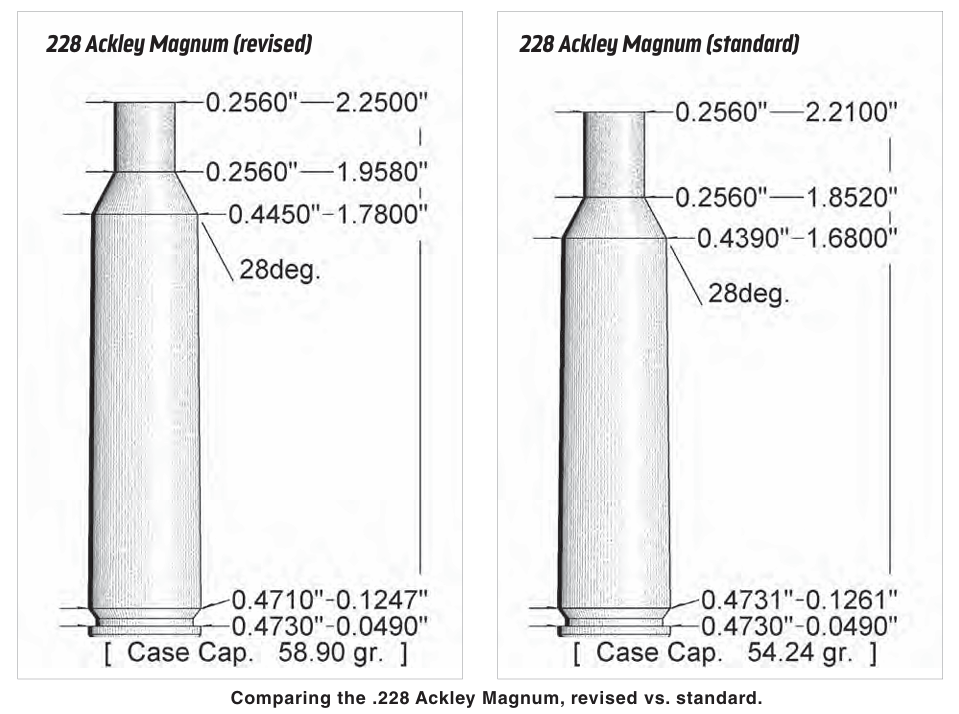
Image taken from Fred Zeglin, P.O. Ackley, America’s Gunsmith. 2017
Parker Otto (P.O.) Ackley was not the first man to “Improve” a cartridge. There had been many names well known before and during his time that were “sharpening shoulder angles” and “decreasing body tapers” to improve cartridge efficiency, function and ballistics. Truth be known every cartridge design is an “Improvement” on a previous cartridge design in some way, shape or form.
In 1938 P.O. introduced the 228 Ackley Magnum which became the first wildcat cartridge in a long line of so named, “Ackley Improved” wildcat cartridges. As it so happened the contents of the “Nike” shoebox included the major components necessary for handloading a 228 Ackley Magnum. Further research revealed I needed to get this rifle in my hands for further inspection.
Looky Here, Looky Here!
Did it have an original Ackley barrel? Was it a 1 in 9 or a 1 in 12 twist? Was it a .224 or .228 caliber barrel? Could it have been an original made by the man himself?
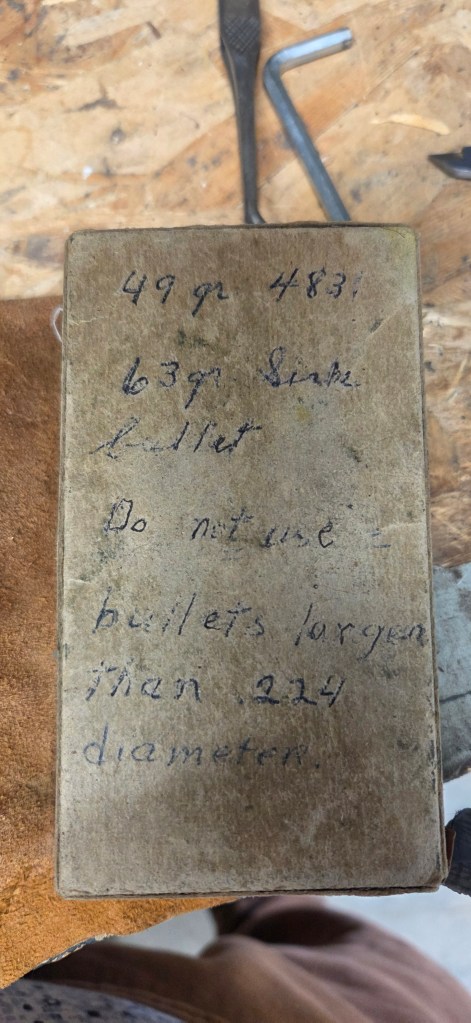
On the underside of the die box was a handwritten note, “49 gr 4831 63 gr Sisk bullet Do not use bullets larger than .224 diameter.” From this I deduced the bore was standard 22 caliber and also the Sizing die being marked “228/224 ACK MG” seemed to indicate the bullet diameter was to be .224 inches.
Careful measurements taken from the brass that had been fired in the rifle revealed that this was the 228 Ackley Magnum (revised) chamber. Running a snug patch through the bore revealed it to have a 1 in 12 twist barrel. The bore has been neglected over the last 50 years but I believe it can again be a reliable shooter.
Building the Ammunition
Now comes my favorite part of the handloading process. I have ammo cans full of military ’06 brass, 7.62 NATO brass, and 5.56 NATO brass. There’s not many a cartridge I shoot that can’t be made from these three parent cases. As it so happens the “Revised” 228 AM was designed to accommodate more easily the use of 30-06 brass as the parent case.
The parent case for the 228 is originally the 257 Roberts. However, 7×57 Mauser and 6mm Remington brass can be used also. The young fella had a box of Remington 257 Roberts ammunition that he wanted to use. I considered this a needless waste especially since I had some 270 Winchester brass on hand.
This is where that start-up cost savings comes into play. I have a good size shelf full of various die sets. I used a 7×57 Mauser Full Length sizer to bump the shoulder back on the 270 Win brass. Next I ran the case through a 257 Roberts Full Length sizer to draw the neck down to 25 caliber. I then trimmed the case to length, 2.240″ and finally ran it into the 228/224 Full Length die to draw the neck down to 22 caliber. I made sure to not push the shoulder neck junction back and actually left a false shoulder for the bolt to close firmly on the case in the chamber.
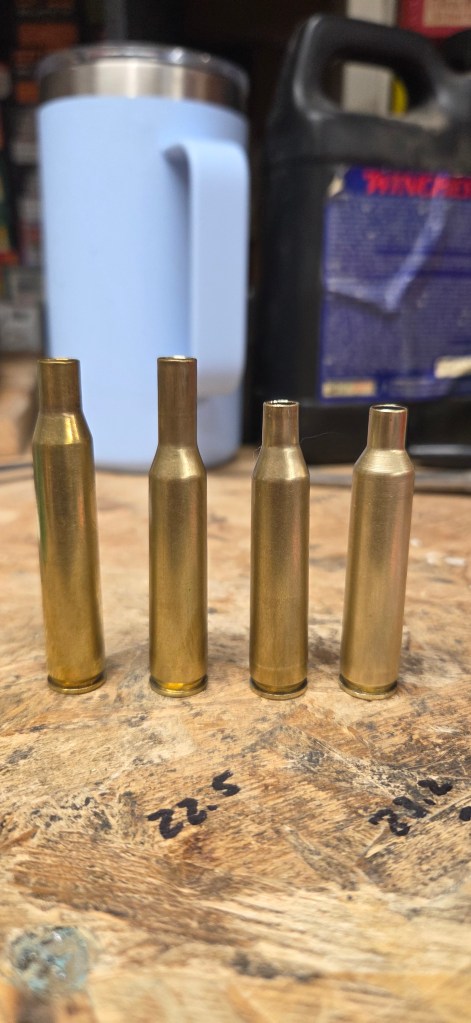
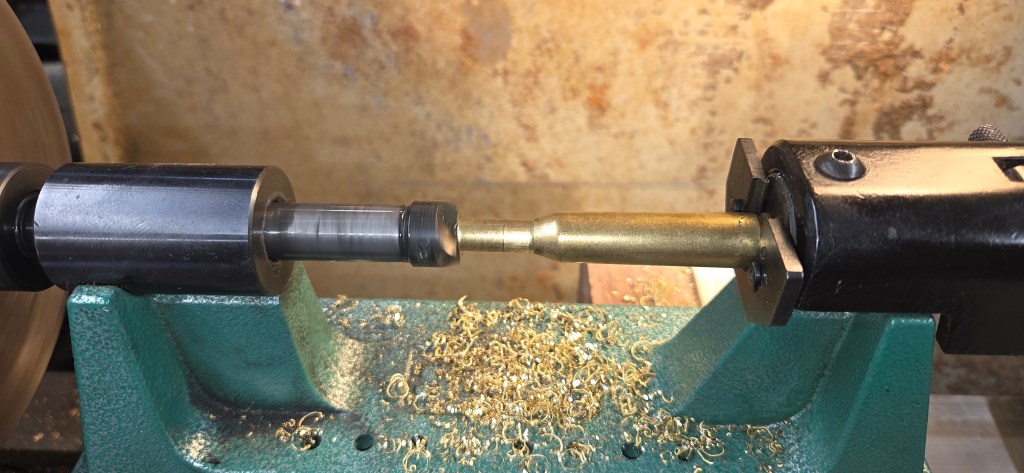
A good 1/4″ of brass has to come off the case to bring it to proper length. This chamber was cut with a generous neck that accommodates the increased thickness of 30-06 or 270 brass when it is used. I suspect that if one were to turn the necks to uniform neck thickness the result would be frequent split necks after firing. Also the continual overworking of the brass through the sizing process would make it brittle and prone to split as well.
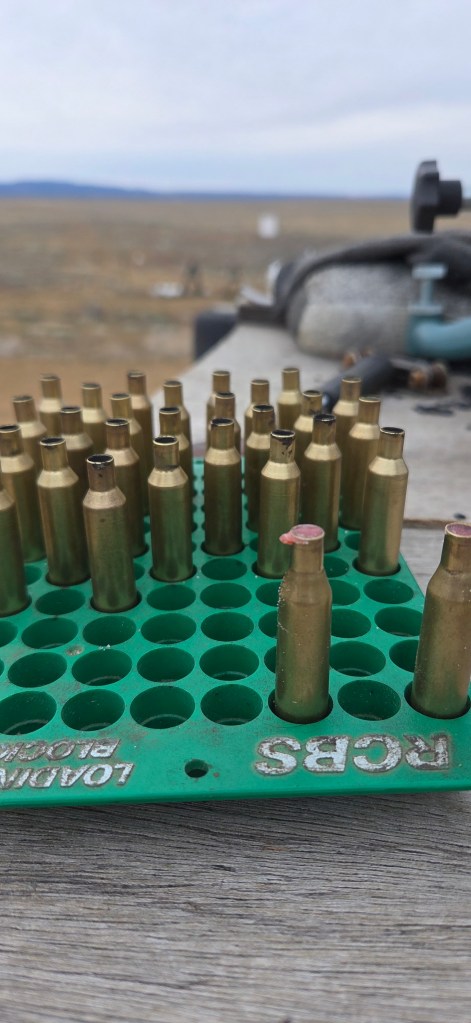
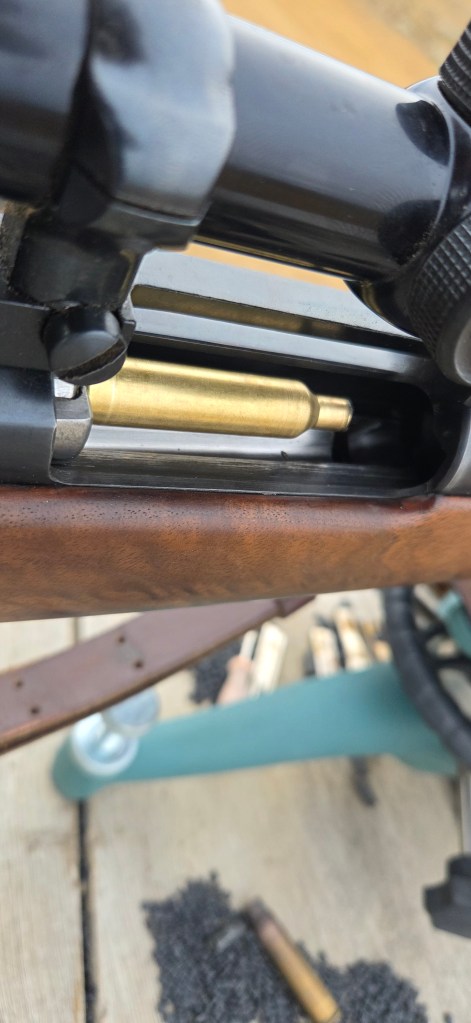
There are several ways to fireform brass. A typical Ackley Improved chamber only needs factory ammunition to be fired in it to form the new brass, this is the main advantage of his improved design. Since there is no factory 22/257 Roberts cartridge to be had that was not an option.
Truth be told every time a loaded round is fired in a chamber it is being fireformed. Everybody does it everyday. The primary difference handloaders want each case fired in a chamber to fit that chamber as tightly as possible each time they fire it. This creates a predictable consistency from shot to shot that results in greater accuracy, efficiency and performance.
Sometimes with light or reduced loads it is suggested that the bullets be seated out in the cartridge so as to “jam” them into the lands of the leade or throat of the chamber. This facilitates a tight bolt closure to maintain a minimum headspace as the cartridge head is held firmly against the bolt face by the bullet engaging the bore. I typically load cast bullets in this manner.
Jacketed bullets can be loaded in the same manner but it is not suggested to use max loads. If one must use jacketed bullets to fireform cases I suggest a light for caliber bullet weight, a medium burn powder and reduce the suggested start load by 3-5%.
Another technique is hydroforming. I have not witnessed this but the principle is simple. The brass case is placed in a die that is dimensionally the size desired, it is sealed and water pressure is applied to expand the case to fill the form die.
The technique I used above was the “Cream of Wheat” method (Malt O Meal actually). I dropped a small charge of fast pistol powder (14.0 gr of W231) into the case, topped it off with the hot cereal, and sealed the mouth of the case with beeswax.
What is the Goal?
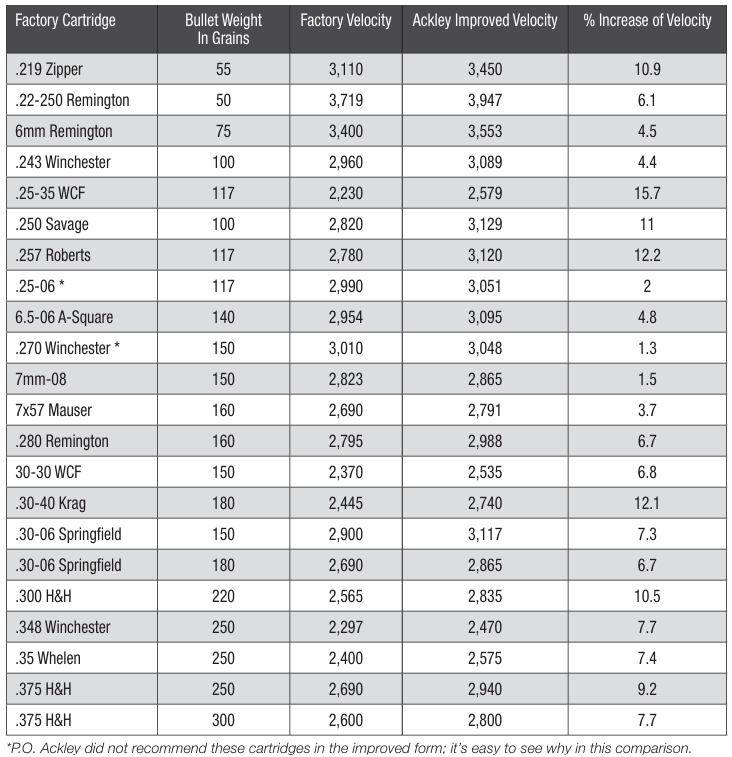
I gave the gentleman a crash course in cartridge comparisons and certain reasonable observable trends that can be observed throughout calibers. I compared the case capacity from the “Revised” cartridge information previous suggesting 58.90 grains and compared this to modern cartridges such as the 223 WSSM and the 22 Creedmoor at 55 and 53 grains respectively.
With this information I suggested that a 55 grain bullet at 4,000+ fps or a 50 grain bullet 4,200+ fps could be very likely, if the bullet would hold together. In case you think this is very optimistic and dangerous thinking, P.O. himself registered 4,000+ fps with a 60 grain bullet in his Volume 1, Handbook for Shooters and Reloaders. With today’s modern powders these velocities I believe are certainly achievable.
With a new chronograph in the works, I’ll be updating this post in the coming weeks. So stay tuned.
DISCLAIMER: RELOADING AMMUNITION IS INHERENTLY DANGEROUS AND SHOULD ONLY BE PERFOMRED BY KNOWLEDGABLE INDIVIDUALS FOLLOWING PUBLISHED LOAD DATA FROM REPUTABLE MANUFACTURERS. THE INFORMATION PROVIDED HEREIN IS FOR EDUCATIONAL PURPOSES ONLY. THE AUTHOR ASSUMES NO LIABILITY FOR ANY INJURY, DAMAGE, OR LOSE RESULTING FROM THE USE OR MISUSE OF THIS CONTENT. ALWAYS FOLLOW PROPER SAFETY PROCEDURES AND COMPLY WITH ALL APPLICABLE LAWS.
 Those Who Can't