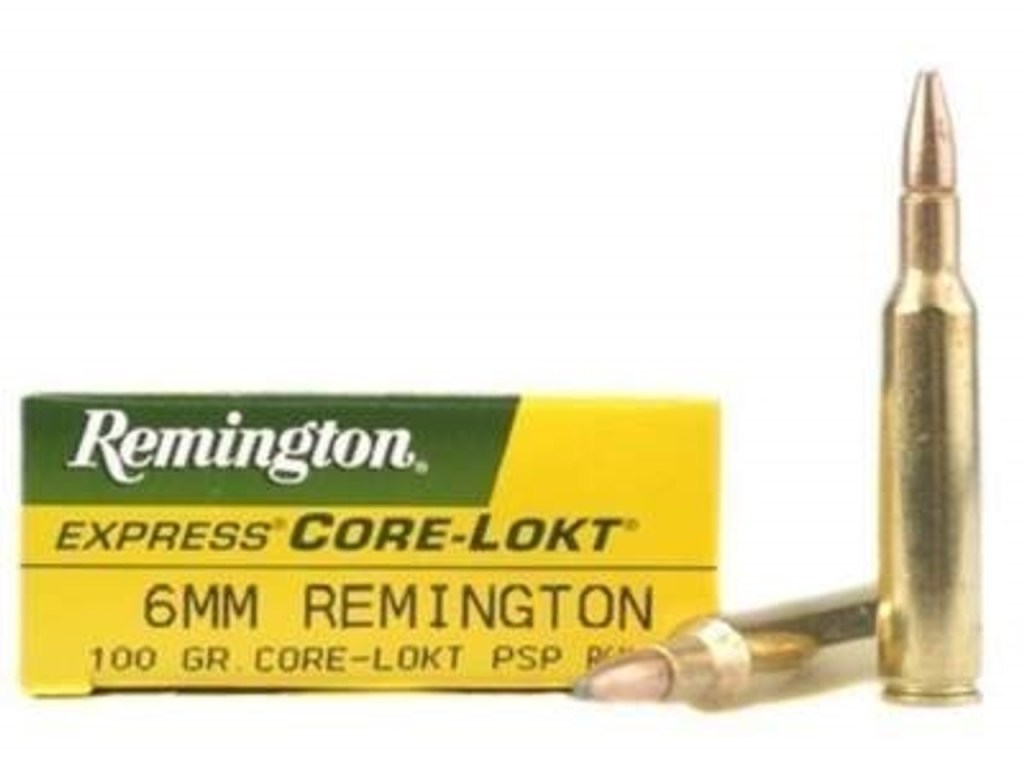
This cartridge is a favorite because it was another custom build for a specific purpose. A has been that should have been but never became. Even Remington’s attempt to rebrand was to little to late, the damage had already been done. Ammunition can be found as there are rifles and shooters a plenty out there but, the real love affair is with handloaders. In my opinion the 6mm Remington is the most capable, most efficient, most underrated and most unknown 6mm cartridge commercially available today.
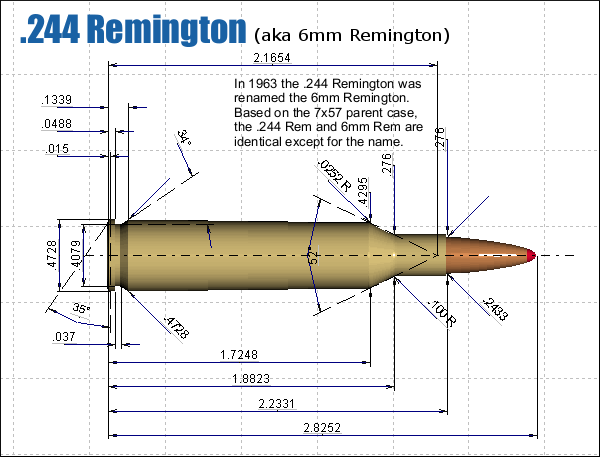
In the 1950s when benchrest and varmint shooting were very popular Fred Huntington and Warren Page wildcatted two cartridges. Fred’s design was based on the 257 Roberts/7×57 Mauser case and became the 243 Rockchucker while Warren’s experimenting was with the new 308 Winchester case and became the 243 Page Pooper.
Winchester adopted Page’s cartridge while Remington adopted Fred’s. The commercialized results were the 243 Winchester and the 244 Remington but the “twist” of the story was both cartridges were initially designed as super varmint cartridges. As shooters and hunters often do, experimentation revealed or at least it was supposed that one cartridge could handle heavier projectiles better than the other due to (you guessed it) a faster barrel “twist” rate. Heavier bullets mean heavier game right? Therefore the 243 Winchester with a 1:10″ twist became, to most, more than it was originally intended for.
Remington attempted to reconcile this issue by re-barreling from a 1:12″ to 1:9″, rebranding from 244 to 6mm and releasing the 6mm Remington. The damage had already been done however, and the 243 Winchester moved on to become the most popular small to medium big game hunting cartridge on the shelf today. There are only a handful of commercially available 6mm caliber cartridges today. In choosing “the best” one is attempting to decide what single topping they would like on their ice cream to make it better than Billy Bob’s sitting across the table.
When all things are considered pound for pound (of pressure), inch for inch (of barrel length), grain for grain (of powder capacity) and dollar for dollar spent on set up and popularity. The 6mm Remington comes out on top. There is one commercial cartridge that bests the 6mm Remington, the 240 Weatherby Magnum, but what do you expect it’s a Weatherby.
In The Field
The 22″ E.R. Shaw barreled 98 Mauser after only a laser bore sight in, printed the first three rounds ever fired down the bore of handloaded 95 grain Nosler ballistic tips in one ragged rough looking .379 inch hole at 103 paces. The group was 3 inches high and 1 inch right of the point of aim. Range conditions that day were less than ideal range conditions but suffice it to say, I was in love at first group.
The next load of 90 grain “X” FB projectiles grouped a little lower in position and opened up to just over .500 inch. The results were obvious, 95 grain Ballistic Tips were gonna be my hunting load.
Due to mechanical issues discovered with the wife’s “Quarter Bob” opening morning (loose scope bases on the receiver) I decided we’ll just “one gun” it. Tooling down a Juniper covered ridge late opening morning I spied an antlered critter lying about 40 yards down a little drainage on the south facing slope. I continued to the end of the ridge about a half mile farther, where it petered out into a cheat-grass flat. I figuring the buck thought we had not seen him so we turned around and drove right back up the ridge. Sure enough, he was laying in the same spot, butt toward the road looking over his other shoulder this time. Again we drove past him only this time I stopped about 100 yards up the two-track.
Getting out of the Pathfinder I eased the door shut, slipped around to the passenger side and helped the wife disembark as quietly as possible. Feeding a round into the chamber, easing the bolt closed and with MY rifle in HER hands we slipped back down the ridge for a shot. Understand that in adobe, “painted desert” Juniper woodland type environments any roads (what we call two-tracks) are usually eroded fairly deep especially on ridges, so as we walked down the ridge in the left hand track we were very well concealed. When we got to the “window” where the buck was visible we simple stepped into the right hand track. This allowed for a head and shoulders view and clear shot over the embankment.
He was still lying in the same position and he saw us as soon as we poked our heads over the berm. I said to Shannon, “Put the crosshairs center of fur, just behind his shoulder.” That 95 grain Ballistic Tip hit him just below the spine and right behind his left shoulder drove through his chest and exited busting his right leg below the shoulder joint as he lay. He rolled over, kicked a few times and expired.
So the first Mule deer MY 6mm killed was MY wife’s 6 x 7, 178″ matching sail point buck, affectionately called “BOB.” Because as far as southern Wyoming desert deer are concerned, this dude had a Big Ol’ Body, you should’ve seen him crammed in the back of that Pathfinder.
I did get to shoot something with it eventually. I dropped a little forked horn buck attempting to dart around a point on a rock ledge about 80 yards away. Same 95 grain Nosler BT caught him behind the shoulder in the chest and folded him like the daily newspaper right in his tracks.
Varmints and Such
Heading in from location work in southern Wyoming one day a reprieve was deemed necessary, especially after purveying the considerable amount of work accomplished by the nearly unnumberable crew of one. Stashing the truck in a low water crossing and proceeding up the draw about 100 yards, I positioning myself on the wrong side of the bank (facing the sun) about 20 yards from the deep wash. I grabbed the hand call and wailed away for about 20-30 seconds. The low rumble of a Bob-tail water truck approached. The rattle of the “Jake” brake as it descended the grade to the low water crossing was very audible.
Great, this was a waste of time I thought as the driver began grabbing gears ascending out of the draw continuing east. No sooner then expressing my feelings in my head I saw movement on the other side of the wash. I swung into position as the dog drew up on my side of the gully 20 yards away. I threw the crosshairs on the center of his chest and squeezed. A big cloud of fur erupted and drifted slowly down the draw, very picturesque with the sun as low as it was at that time of day.
The next stand was a mile or so up the road. I pulled off in the barrow ditch and slinked around this adobe nob about 150 yards out. Setting up I had clear view of a shallow inclined sagebrush flat extending for about 350 yards to the south of my position. A few blasts on the hand call and wait. Ten minutes in I saw movement about 250 yards out and slightly to my left. He was slowly making his way down toward me. A few lip squeaks and his vigor was renewed.
There’s no way he can’t see the truck I was thinking. Oops, spoke to soon. That’s about 150 yards I think, dead center hold, dead dog. After squeezing the trigger it was legs up and white belly, sure enough coyote number two in less than 30 minutes. Next stop was at a little 3.5 acre size stock pond half a mile up the road.
This time the dog come from the head of the pond in the lush grass and deep sage all the way around to the west of the pond and across the dyke coming straight at me. At about 50 yards he skidded to a stop, I guess he could see the truck. Looking hard to his right, I leveled the 6mm on the center of his chest. Pow! That was #3.
Three for three, I was on a roll. Fifteen minutes of sunlight and five minutes up the road I was in position. I hadn’t even finished the call series and here he was coming hard from my left about 100 yards away. He disappeared in a little swale in between us and seconds later he reappeared 90 degrees to my right and 15 yards away. I swung the rifle, he spun on his hind feet, I saw Coyote in the scope and let ‘er fly. As quick as my reaction time was his was just a little quicker. I missed at 15, then at 60 and again where he hit the sage at 120 yards.
A favorite coyote load consists of a Hornady 87 grain SP. This is my load for vermin and varmints. I know, it’s not a 55 gr VMAX moving along at 4,000 fps like a 243 Winchester. It could, if you really wanted to and even at more speed if loaded to the same pressures, but why? It’s a coyote and you can’t get any deader than dead. My load pulls double duty, as it so happens it is an awesome antelope load as well out to 300+ yards. That little 87 grain bullet at lower velocity acts like a premium hunting bullet and will anchor any antelope (buck or doe) or deer (young buck or doe) drilled through the shoulders with Partition like performance.
In Conclusion
In my opinion, “and I am unanimous in this,” the 6mm Remington is the best of the Sixes and that’s why it is my favorite medium game hunting cartridge. By medium game I mean anything 250 lbs or less (the number is arbitrary really). Can it kill a 325-450 lb mature buck during the rut? Sure but I feel there are better options considering the conditions one may face during these type of hunts.
“Well I use a 243 Winchester on elk.” Good on you partner. I would venture to say you know your rifle very well and wait for ideal conditions or you’ve just been very lucky. Recent projectile development has been remarkable in expanding the conditions in which a marginal cartridge has become more viable. These cartridges while possibly more viable still have conditions which is why they are marginal to begin with.
Plan and use a cartridge that will work in the most possible conditions you may encounter, then learn it, let it become a part of you as you become a part of it. Anything less is equivalent to bringing a knife to a gunfight, you may win but the odds are stacked against it.
 Those Who Can't